"PORTRAIT OF A POLITICIAN VOMITING" - 16 Rue des Quatre Fils, Paris
Click for more information on
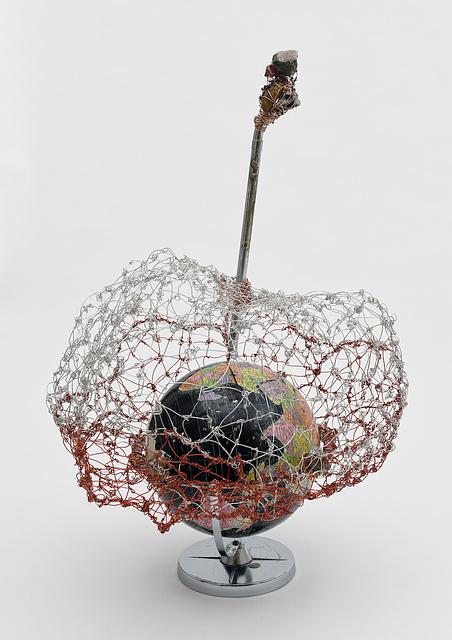
RX&SLAG Paris is delighted to present the first solo exhibition in France by the Jamaican artist Arthur Simms.
Born in 1961 in Kingston, Jamaica, and now based in the United States, Simms has for several decades been developing a distinctive sculptural practice based on the assembly, fastening and tensioning of industrial fragments, domestic objects and organic materials. His structures, often vertical and sometimes totemic, explore the notions of balance, memory and transformation, giving rise to forms that are both fragile and architectural. Building on the legacy of post-war assemblage whilst developing a deeply personal language, Simms transforms materials steeped in use and history into structures where tension, accumulation and balance become vectors of memory and experience.
The artist’s work has been featured in numerous major international events, including the Kingston Biennial (2022) and the Venice Biennale, where he participated in Jamaica’s inaugural pavilion in 2001 and in projects linked to the 2019 edition. Simms has also created several public installations and large-scale interventions in urban spaces, including a floating sculpture presented on the Staten Island waterfront in 2018, an installation at Socrates Sculpture Park in New York, and more recently A Totem for the High Line (2024–2025).
His work has been exhibited at numerous international institutions, notably MoMA PS1 in New York, and is now held in several major public collections, including the Whitney Museum of American Art, the Hirshhorn Museum and Sculpture Garden, the Yale University Art Gallery, the Museum Brandhorst in Munich, the Neuberger Museum of Art, and the Aïshti Foundation in Beirut, amongst others.
In the United States, the artist is also represented by Karma and Martos Gallery.
Simms’s sculptures are characterised by a constant tension between fragility and monumentality. As the critic Glenn Adamson has observed, his work brings together disparate elements to create structures in which objects accumulate memory and physical presence, transforming the assemblage into an architecture of relationships and stories.